Your Gym's Strongest Marketing Asset Isn't the Equipment. It's the Culture.

I noticed something at my gym.
There’s a particular time when the rush disappears.
Sometimes around 11-12 AM. Sometimes later in the evening.
The staff who have spent the day cleaning equipment, organising weights and maintaining the space finally get a few minutes.
And I’ve watched some of them start training.
And they train.
Heavy weights. Proper biceps. Consistency.
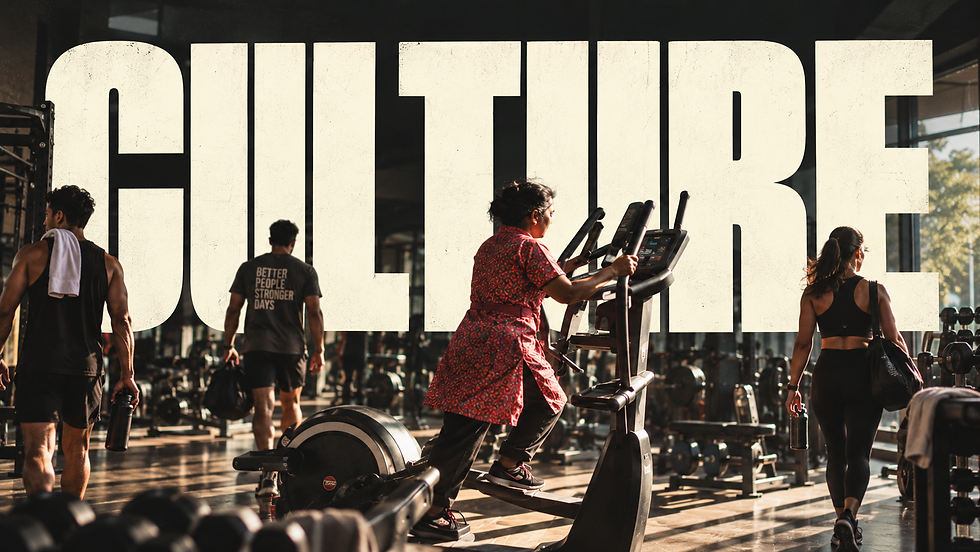
That made me think:
When even the people working around your product start adopting the behaviour your business stands for, you've built something bigger than a service.
You've started building a culture.
And fitness in India is becoming a serious business.
India's commercial fitness market was estimated at ₹16,200 crore in 2024 and is projected to reach approximately ₹37,700 crore by 2030, growing at around 15% annually.
Memberships are projected to grow from 12.3 million to 23.3 million during the same period.
But the more interesting number for a founder is this:
Boutique fitness studios are projected to grow at around 18.8% CAGR, with Deloitte pointing specifically towards increasing demand for personalised, immersive and community-driven fitness experiences.
Read that again.
Not just better machines.
Community-driven experiences.
Because equipment isn't a moat.
Another gym can buy the same equipment.
They can hire another trainer.
They can copy your membership price.
They can copy your interiors.
They can even copy your Instagram content.
What is much harder to copy is how your place feels.
The staff who train there.
The member who has been coming at 6 AM for four years.
The trainer everyone knows.
The receptionist who remembers names.
The friendships built between sets.
The Saturday ritual after a group class.
The language people use inside the gym.
That's culture.
And culture eventually becomes brand.
We see this outside fitness too.
One company I find interesting from this perspective is Zomato.
You don't have to agree with every decision the company or its leadership makes to recognise that Zomato has deliberately thought about organisational culture for years.
Deepinder Goyal was writing publicly about hiring people who could solve problems and take ownership as far back as 2011. Zomato later wrote that the growth of the business, personality of the brand and company culture depended on the people carrying it forward.
By its tenth anniversary, Goyal described the company's early years as a period spent building a “solid cultural DNA.”
People have joined. People have left. The company has changed enormously.
But the identity became recognisable.
And that's the point.
Culture doesn't mean everybody stays forever.
It doesn't mean free coffee, motivational posters or calling employees a “family.”
Culture is simply:
What behaviour becomes normal when nobody is explaining the rules.
In a gym, does the staff train?
Do trainers genuinely care about members' progress?
Do beginners feel intimidated or welcomed?
Does somebody notice when a regular disappears for two weeks?
Does the team itself believe in fitness?
Does your community exist outside a membership transaction?
Those things eventually become visible to customers.
And then you market it.
This is where a lot of businesses get the order wrong.
They try to manufacture a brand on Instagram first.
Build the behaviour first. Document it second. Market it third.
That cleaner lifting weights?
That's a story.
The 45-year-old woman who entered a gym for the first time?
That's a story.
The member who's been coming every morning for five years?
That's a story.
The trainer who remembers everyone's injuries?
That's a story.
But don't manufacture these moments because you need a Reel.
Create a business where these moments naturally happen.
Then your marketing team has something worth talking about.
If you're entering the fitness market now...
Don't only ask:
Which machines should we buy?How premium should the interiors look?What membership offer should we launch with?Who will manage Instagram?
Also ask:
What kind of people do we want this place to create?
Because India's fitness market is getting bigger.
More gyms will open. More Pilates studios will open. More wellness concepts will arrive. More money will be spent on interiors, technology and content.
And when everybody eventually has beautiful equipment and beautiful Instagram feeds, culture becomes differentiation.
Your brand isn't only what customers see on Instagram.
It's what your people start believing when Instagram isn't watching.


Comments